Science club joins Wilton Frog Pond study
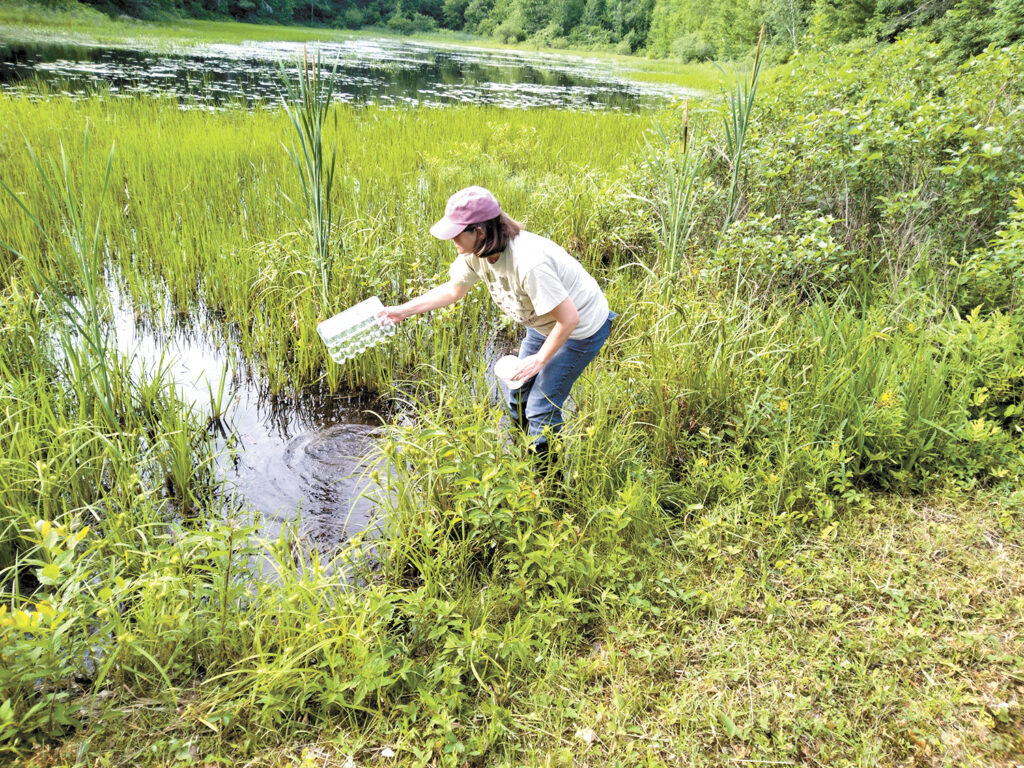
Michele Decoteau collects water from the Frog Pond. Samples were kept in the egg cartons.
WILTON – Invertebrates, those tiny “critters” that live in our ponds and streams, are indicators of the health of the water body. Their absence is an indicator of the presence of pollutants.
On June 21, the Wilton Public/Gregg Free Library’s Science Club joined with a program sponsored by the Wilton Collaborative Space to learn about water testing and to study the water in The Frog Pond, a town-owned conservation area. The students’ field trip was guided by Children’s Program Director Bettielou Hill (known to her kids as “Miss Boo”) and Collaborative Space Coordinator Sandy Lafleur.
The water testing and examination of what was found was directed by Michele Decoteau, until recently the town’s stormwater program manager. Testing the Frog Pond was the second in her series on water testing for the Collaborative Space. Because the Science Club was scheduled to meet on the same day, the programs were combined.
“It was all very low tech,” Lafleur said. “When people think of testing, they think test tubes and water colors. This wasn’t like that. It was learning about water quality by the creatures living in it. There are certain creatures that are very pollution intolerant. If you find them there, the water isn’t polluted, even if it looks murky.”
They also tested the pH (the acidity of the water), the temperature and oxygen content. “Temperature is very important,” she said, “but the kids were more interested in seeing the critters. It was a beautiful day.”
They found ten “critters” in the water including the larvae of dragonflies, mosquitoes; juvenile salamanders, water scorpions, caddis, Dobson, and stone flies, and water boatmen, as well as tadpoles and seeing a couple of frogs. The indication is a “clean water body.”
After examination, the critters were returned to the water. “Michele made sure the kids knew these were living creatures and needed to be taken care of. She did a fantastic job.”
Students were required to be accompanied by an adult, Lafleur said, “and the adults all got involved. Especially the fathers.”
Total attendance was seven children and ten adults.
Current plans include another meeting of the Science Club on July 14 at the Collaborate Space, another water testing session in a different place, and to repeat the tests at the Frog Pond on August 11, to make a comparison.
The Frog Pond was created in the 1920s as an emergency water source for the Hillsboro Mills in Pine Valley. It is a town-owned conservation area, open to the public and accessible from both Maple Street and Whiting Hill Road near the town garage.
Hill created the Science Club for elementary school students during the pandemic shutdown, she said, beginning with a three-month Zoom program.
“Using the Collaborative Space gives us space large enough for parents and kids to do experiments together and in person. I want it to be as hand’s-on as possible.”
The program began with one family, she said, “and in April we had 12 kids and 12 parents. It continues to grow, which is very exciting.”
The Collaborative Space, located in the Second Congregational Church Parish House on Gregg Street, is a project of the Wilton Public/Gregg Free Library and made possible in part by the New Hampshire State Library and the Institute of Museum and Library Services.
Cabinet News

Alleged Sky Meadow shooter wanted to punish the rich

Political newcomer Manzur campaigns in Milford
Homeland Security scraps plans for Merrimack ICE facility

Local students achieve academic honors at Hofstra

Local residents achieve academic honors at Simmons University