
Fire officials offer sage advice for holiday season
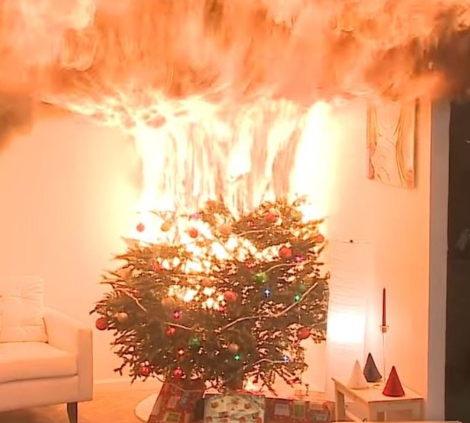
Fire officials warn that dry Christmas trees can become engulfed in flames in as little as 40 seconds. Courtesy photo
A fully decorated Christmas tree is a beautiful sight to behold — and it can also be a catastrophe waiting to happen.
According to the National Fire Protection Association, even the smallest spark will instantly set a dry tree ablaze. Because of its porous nature, a Christmas tree will draw more oxygen, causing it to burn faster than newspaper. A deadly flashover can occur in just 40 seconds. In contrast, it typically takes three minutes for a family to escape from a burning home.
“Live Christmas trees can be powerful fuel sources, especially when dry,” said James Shanley, director of the National Association of Fire Investigators. “At its peak, a burning six-foot tree can give off the same heat as 40,000 100-watt light bulbs.”
As the fire rages, the room temperature at floor level can reach 100 degrees while the temperature at eye level can soar as high as 600 degrees. At this temperature, clothes will melt to a person’s skin and their lungs will be scorched by the intense heat.
Therefore, when choosing a tree, needles should not fall off when pulling your hand along the branches. If that happens, the tree is already too dry.
Placement is also a key factor. The tree should not block doors or windows that would be used to escape a fire. The tree should also be at least three feet away from heating vents, fireplaces or other heat sources.
When decorating the tree, fire officials recommend using LED lights. The lights should be turned off when no one is home and before everyone goes to bed. According to the NFPA, 41 percent of Christmas tree fires start because of poor electrical distribution or faulty lighting equipment.
For outside decorating, consumers are urged to use lights that are specifically designed for outdoor use. Fire officials suggest using a ground-fault circuit interrupter, which can be installed by an electrician or purchased for portable use. Consumers should be aware that a 15-ampere circuit can support 1,800 watts and a 24-ampere circuit can support 2,400 watts.
Cabinet News

Local student achieves academic honors at Syracuse

Local students achieve academic honors at Lasell

House fire claims life of Wilton woman

Hassan tours renovated Early Ed Center at Merrimack YMCA

Cher’s son arrested in NH twice in two days
Mother of Sen. Hassan dies at 94
It is with sadness and much love and appreciation that U.S. Sen. Maggie Hassan and her siblings, Franny and Frank ...