Melendy Pond couple clash with Brookline over residency
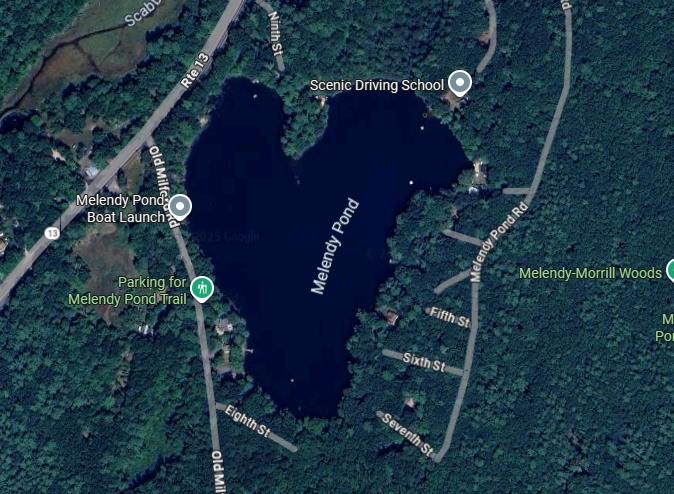
The land around Melendy Pond in Brookline continues to be a point of contention between the town and those who have homes on the pond. Courtesy photo/Google Maps
BROOKLINE – Since moving to Melendy Pond in 2022, Peter and Greta Rondeau have been at odds with town officials regarding the status of their residency.
In November 2025, the couple filed a lawsuit against the town stating that because they live on Melendy Pond, they continue to be denied the right to vote, enroll their children in public school or even have a library card.
In his Complaint, Attorney Nathan Fennessy, counsel for the Rondeaus, said the town leases land in the Melendy Pond Community to bolster property tax revenue. The Residence Provision in the lease states that tenants will “not claim to be residents and will forfeit all the rights and benefits incidental to residency.” This has allowed the town to minimize the number of low-income residents and prevent overcrowding in the schools while continuing to make money.
Fennessy said his clients are now seeking declaratory judgment and injunctive relief to prevent the town from enforcing the Residence Provision.
He said the town began leasing land around the pond in the late-1940s. The Melendy Pond Authority was then established in 1951. The leases originally had 20-year term limits and allowed tenants to build on the lots.
The Melendy Pond Authority acquired the property from the town in 1971 and implemented a series of new residency restrictions and term limits. Problems began to surface four years later.
“In 1975, the Melendy Pond Authority evicted a homeowner for the first time for attempting to obtain the benefits of residency,” said Fennessy.
In 1993, Brookline officials increased the assessed value of each lot by $40,000 to “represent the benefit of leasing land in close proximity of Melendy Pond.” As a result, Fennessy said tenants were burdened with a higher tax rate to cover the increased value. The tenants fought back for the next five years and ultimately forced the town to reimburse the tax payments with interest.
In 2002, the town voted to terminate all the leases and demolish every home around the pond by 2032. Fennessy said there is no plan to compensate the tenants should that come to pass.
The Melendy Pond Authority was dissolved following a Town Meeting vote in 2019 and the land was transferred back to the town. The Selectboard then voted to establish the Melendy Pond Management Committee.
“Residents within the Melendy Pond Community are not permitted to serve on the committee,” said Fennessy, adding that the committee does not perform any of the necessary maintenance despite having more than enough money from the inflated lease fees.
The Rondeaus were aware of the Residence Provision when they moved into their home on Second Street three years ago. Since then, they have requested the legal basis for the provision; however, they have not received an answer.
In addition, Peter Rondeau has not been allowed to run for the Selectboard or vote on the Economic Development Committee as he is “not a town resident.” However, according to the Assessor’s Database, the Rondeaus own Lots 3 and 4.
Fennessy said that in December 2024, the Rondeaus signed new five-year leases for both lots. In addition to property taxes, the leases required them to pay $3,940 in annual rent for 2025. The Rondeaus are also required to leave for 30 days each year to prevent the lots from becoming “the legal residence for any person, whether for voting, vehicle registration or other purposes.”
“Town officials have acknowledged that they cannot technically prevent Melendy Pond Community members from voting but, if anybody on Melendy Pond registers to vote, then the town will kick them out of their homes,” said Fennessy.
Regarding their children’s education, the Rondeaus have been advised by school officials that the town regularly checks students’ addresses to make sure that none of them live on Melendy Pond.
“There is no remedy at law that is adequate to replace the fundamental rights to vote and to a public education in Brookline. A declaration that the Residence Provision is unconscionable and unenforceable is thus necessary to afford the Rondeaus the relief they require,” said Fennessy. “Members of the Melendy Pond Community are deprived of rights afforded to all others residing in the town, including homeless or unhoused members of the community.”
In response, the Selectboard issued the following statement at its meeting on Dec. 8, 2025: “The town of Brookline has been named in multiple lawsuits, as well as a HUD Complaint, brought by the Rondeaus, two Melendy Pond lessees. The Rondeaus have collectively signed four separate Melendy Pond Leases agreeing to their terms, which were approved by an affirmative vote of the town residents at the 2019 Town Meeting. Furthermore, as required by the lease, these lessees provided sworn affidavits that they have permanent legal residence elsewhere. However, these lessees are now arguing these terms are too restrictive despite agreeing to the lease terms, which clearly state that the Melendy Pond lots are to be used for seasonal and recreational purposes only and cannot be used to establish domicile or residency in the town of Brookline. Indeed, the Melendy Pond lots are taxed at a reduced rate for this reason. While these lawsuits will cost the Brookline taxpayers’ legal fees to resolve, we strongly believe it is our duty to defend against these claims and honor the will of our fellow Brookline residents.”
Cabinet News

Hassan tours renovated Early Ed Center at Merrimack YMCA

Cher’s son arrested in NH twice in two days
Mother of Sen. Hassan dies at 94
It is with sadness and much love and appreciation that U.S. Sen. Maggie Hassan and her siblings, Franny and Frank ...

Stay Work Play NH announces 2026 Rising Stars Leadership Cohort

Applications being accepted for Brodsky Prize