Melendy Pond residents rail against Brookline as Town Meeting resumes
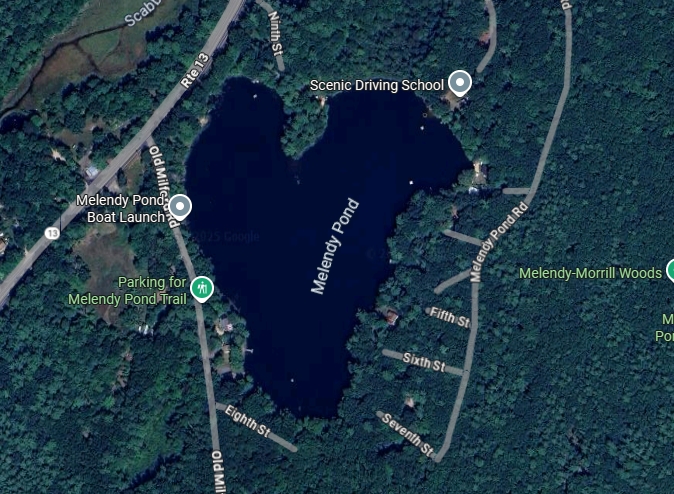
The land around Melendy Pond in Brookline continues to be a point of contention between the town and those who have homes on the pond. Courtesy image/Google Maps
BROOKLINE – Although they are not allowed to speak or vote at Town Meeting, Melendy Pond residents have voiced their staunch opposition to the town’s residency restrictions and a warrant article that threatens to take away their homes.
During the first session of Town Meeting on March 14, residents voted against Article 23 by a tally of 64-97. The article would have authorized the town to demolish any buildings located on land owned by Brookline. Because that article failed, residents will be presented with Article 24 when Town Meeting goes back into session on March 28. The article is fully supported by the Selectboard and asks residents “To authorize the Selectboard to demolish any structures located on Lot B-55, a Town-owned property, and to take all lawful actions necessary to carry out such demolition, subject to the availability of appropriated funds as outlined in RSA 41:14-a.”
Should the article pass, all the homes on Melendy Pond would be demolished by 2032 to make way for an 11-unit subdivision, which town officials claim would be more profitable.
The Residence Provision in the lease currently states that tenants will “not claim to be residents and will forfeit all the rights and benefits incidental to residency.” These rights include voting, holding town office, enrolling their children in public school and even having a library card.
Peter Rondeau said things were not like this when he and his family moved into their Second Street home in 2022.
“People had been living here, registering cars and voting here for years and the town admitted they couldn’t really do anything about it,” he said.
He also said the pond held many fond childhood memories.
“I played in the pond and explored the woods, now my kids are,” said Rondeau. “Having traveled and lived in different places and in different communities, we wanted to live in a community that resembled what’s referred to as a ‘cottage court’ community where small homes are close together around a shared resource.”
However, Rondeau said the terms in the Residence Provision started to change in 2024 when Selectboard Chairman Eddie Arnold began “re-interpreting things.”
“Melendy traditionally had a great community and family culture, town politics have killed that,” said Rondeau.
Aaron Crandlemere also said the restrictions were not nearly as tight when he moved into his home on Fifth Street 10 years ago. However, this quiet neighborhood is being crushed by Brookline’s iron fist.
“It’s quite a predicament,” he said of the current situation. “We’re kind of wondering where our families will go, we have rights.”
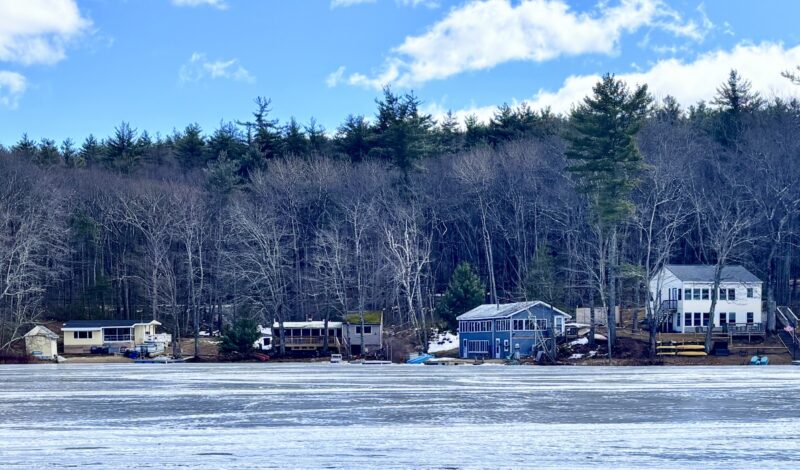
Crandlemere said none of the homes are trailers, which means they would be destroyed if the leases are terminated.
“These houses are on foundations,” he said.
While residents own their homes, they must lease the property from the town.
Crandlemere also said he must leave for 30 days out of the year.
“We’re not allowed to claim this as our residence,” he said.
In addition, Crandlemere said he must list the town on his homeowners insurance policy. However, he recalled an instance where a tree, on town-owned land, fell on his truck. Yet, Crandlemere was told that the town would only be held liable if he could prove neglect.
Randall Farwell has owned a home on Ninth Street for the past 14 years ago and currently has it as a rental property. He was aware of the Residence Provision when he bought the house.
“I knew it was a unique property,” said Farwell.
He said that in 2017, the lease fee was $150 per year. That figure has since jumped to $4,000 per year. Farwell must also have the property vacant for eight months out of the year — the vacancy period used to be 14 days.
“They’ve taken value from me,” he said of the town officials. “The assessed value keeps depreciating.”
Farwell also said that by knocking the homes down, the town would only exacerbate the larger housing crisis.
“It’s obscene to me to be tearing these places down,” he said.
A former resident who asked to remain anonymous, moved into her home on Ninth Street in September 2020.
“It was right on the water, it was really a beautiful place,” she said.
However, like so many others, the Residence Provision became a growing problem.
“They have no right to tell you when you can and cannot be there,” she said. “It’s a sad thing what they’re doing.”
During their time on the pond, she and her husband invested more than $100,000 in home improvement projects. Yet, because of plummeting property values on the pond, they were only able to sell it for $65,000.
Town officials did not respond to requests for comment.
Cabinet News

NH Dems slam Brown and Sununu on healthcare
Melendy Pond homes at mercy of Town Meeting

Nashua man charged with attacking infant son

State Police make hundreds of traffic stops and more than a dozen arrests on St. Patrick’s Day

All are welcome at Amherst Lions Club 52nd Annual Pancake Breakfast