Remembering the final signer of the Declaration of Independence
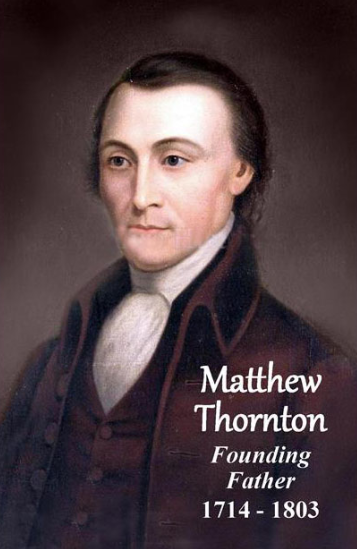
John Hancock will forever be known as the first of 56 delegates to sign the Declaration of Independence while Dr. Matthew Thornton of Londonderry has the distinction of being the last delegate to leave his mark on one of America’s greatest documents.
Born in Northern Ireland in 1714, Thornton and his family immigrated to the U.S. when he was three years old and settled in what is now Wiscasset, Maine. However, they were compelled to leave in the summer of 1722 when the settlement was attacked by Abenaki indians. Following the attack, Thornton and his family moved to the safe haven of Worcester, Mass. where he received his medical training. In 1740, Thornton moved to Londonderry to begin his medical practice and served as a doctor in the New Hampshire Militia during King George’s War.
Thornton’s rise to prominence began in 1775 when he was elected president of the New Hampshire Provincial Congress and worked on drafting the New Hampshire Constitution. The document was ratified in January 1776 and New Hampshire became the first colony to have its own Constitution. Also in 1776, Thornton became a member of the Second Continental Congress and served in that capacity for two years.
The Declaration of Independence was officially signed in August 1776; however, Thornton was initially too late to sign it as he did not arrive in Philadelphia until November. Upon learning this, he insisted that he be permitted to add his signature and thus, have the “privilege to be hanged for patriotism.” Thornton’s name appears in the bottom right corner of the document as space was not available next to the other New Hampshire delegates, Dr. Josiah Bartlett of Kingston and Brig. Gen. William Whipple of Portsmouth.
Thornton later went on to serve three years as a state senator and one year as a state councilor. Although he never held a law degree, Thornton was also a chief justice of the Court of Common Pleas and as a judge in the New Hampshire Superior Court.
After retiring in 1782, Thornton purchased a large farm in Merrimack and operated a ferry on the Merrimack River.
Thornton died on June 24, 1803 at the age of 89 while visiting his daughter in Newburyport, Mass. He is buried in Thornton Cemetery in Merrimack.
Thornton will forever be remembered for his love for New Hampshire and for his country.
Cabinet News
PSU to host State History Contest on April 10

Nashua Regional Planning Commission announces two household hazardous waste collection events

Melendy Pond resident advocates for open school enrollment
New Hampshire Lottery unveils spectacular new $30 scratch ticket

Member of Ayotte’s security detail pulls Massachusetts man from flames