Nashua and Merrimack recognize 25th anniversary of 9/11
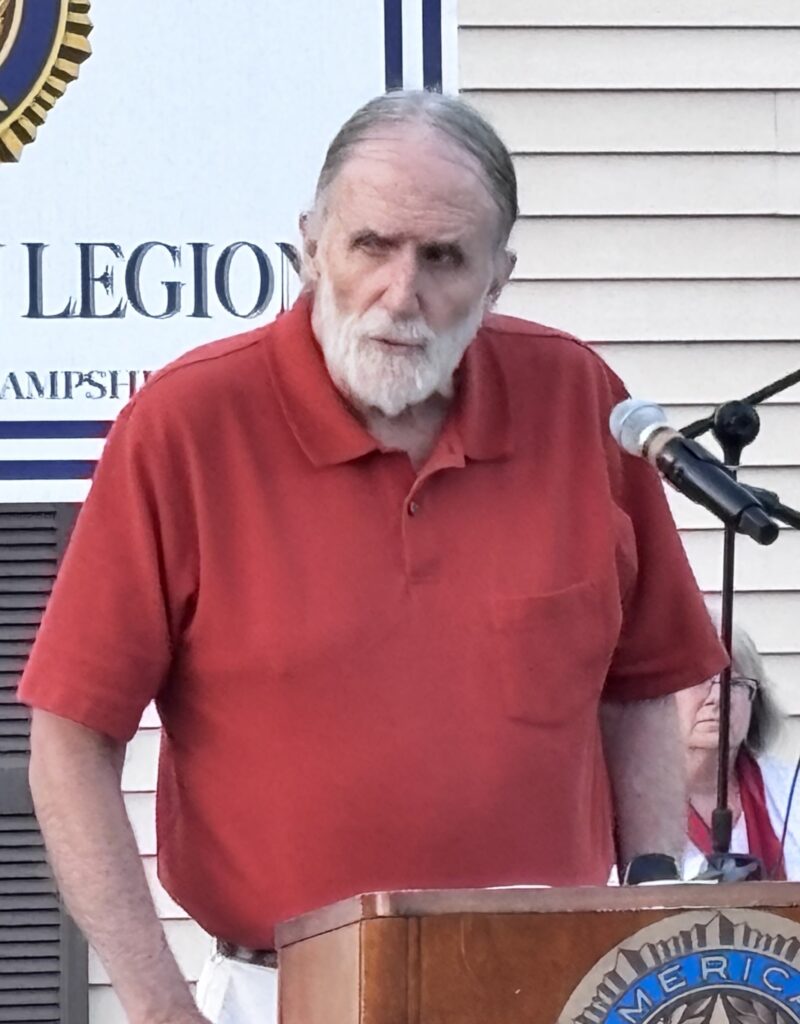
Merrimack resident Kenneth Reilly spoke about how he was supposed to be on American Airlines Flight 11 during this year's Sept. 11 Remembrance Ceremony at American Legion Post 98 in Merrimack. Cabinet photo by CHRISTOPHER ROBERSON
First responders and local officials in Nashua and Merrimack joined countless other communities around the country last Friday to acknowledge the quarter century that has passed since the worst terrorist attack in American history.
In Nashua, Mayor James Donchess remembered the countless number of first responders who raced to Lower Manhattan on the morning of Sept. 11, 2001.
“They ran toward the horror in front of them so that others could escape it,” he said. “The impact of Sept. 11 reached far beyond that single day.”
Douglas Cotreau, commander of Disabled American Veterans Gate City Chapter 7, recalled the incredible bravery shown by the passengers of United Airlines Flight 93.
After hearing from their loved ones about the attack in New York and American Airlines Flight 77, which struck the Pentagon, the passengers on Flight 93 knew they were next. Led by Thomas Burnett, Todd Beamer, Jeremy Glick and Mark Bingham, they stormed the cockpit and were able to redirect the aircraft away from its target in Washington D.C. and into a field in Shanksville, Pa.
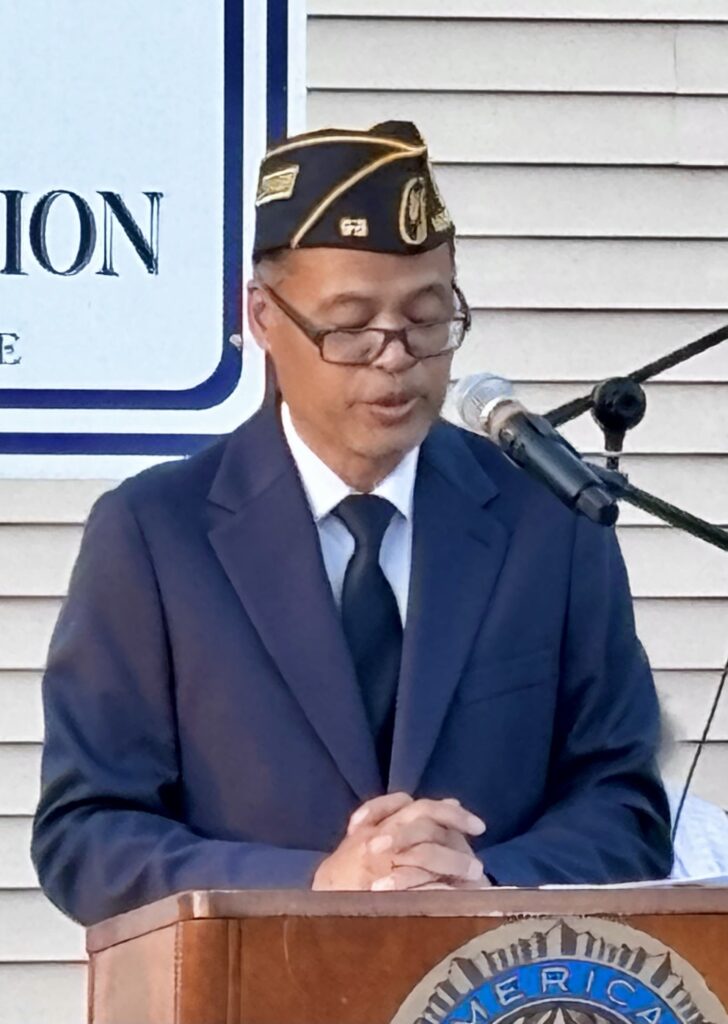
John Elias, commander of American Legion Post 98, delivers his remarks during this year's Sept. 11 Remembrance Ceremony at American Legion Post 98 in Merrimack. Cabinet photo by CHRISTOPHER ROBERSON
“Even when confronted with absolute evil, the human spirit can rise to great heights,” said Cotreau.
In Merrimack, resident Kenneth Reilly said he was scheduled to fly to Los Angeles on American Airlines Flight 11 the morning of Sept. 11 for a conference. However, his managers asked him repeatedly to leave on Sept. 10. Reilly initially resisted, but ultimately agreed to fly out to the West Coast a day early. Had his managers not been so persistent, Reilly would have been killed on Flight 11.
Jason Kelley of VFW Post 8641 said one of his close friends, Charles Jones, was on Flight 11 for a routine business trip for his employer, BAE Systems.
“I feel that our country came out stronger on Sept. 12,” said Kelly. “We need to get back to that.”
John Elias, commander of American Legion Post 98, described the heroism of Welles Crowther, an equities trader and volunteer firefighter on the 104th floor of the South Tower. He used a red handkerchief to cover his nose and mouth as helped people evacuate. He was killed when the tower collapsed and later became known as the “Man in the Red Bandana.”
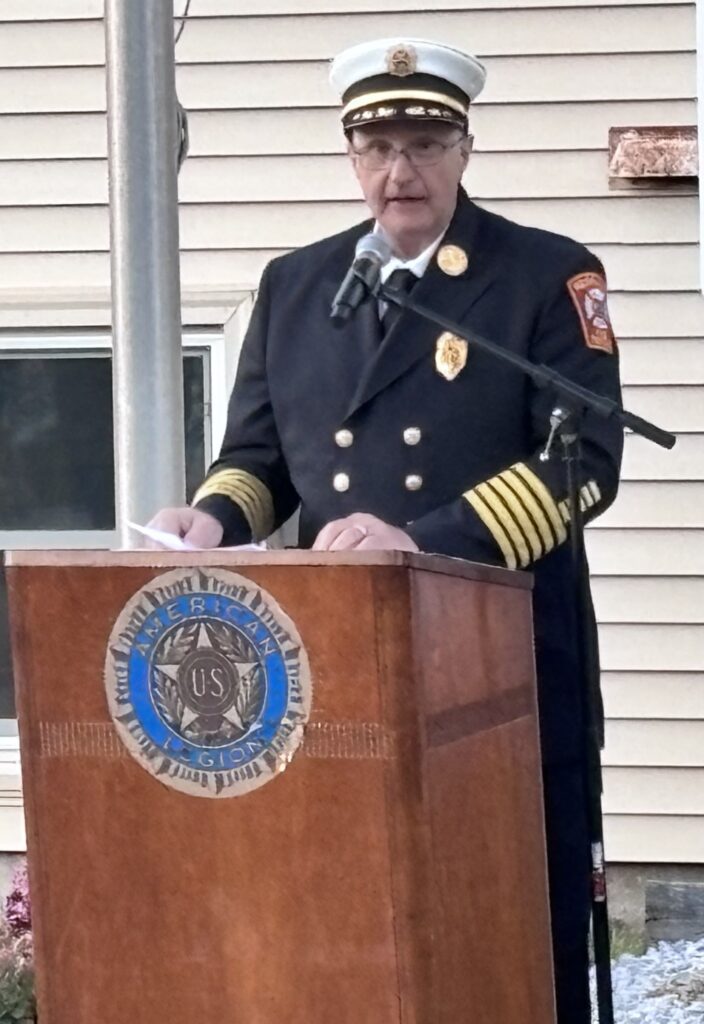
Merrimack Fire Chief Joseph Guarnera delivers his remarks during this year's Sept. 11 Remembrance Ceremony at American Legion Post 98 in Merrimack. Cabinet photo by CHRISTOPHER ROBERSON
“We continue to be inspired by acts of courage,” said Elias.
He also spoke about the Pulitzer Prize-winning picture taken by Thomas Franklin of The Bergen County Record. It depicts three firefighters hoisting the American Flag at Ground Zero.
“The flag was everywhere,” Elias said of the days following the attacks.
Franklin’s picture was eerily similar to the picture of six Marines who hoisted the American Flag at the summit of Mount Suribachi during the World War II Battle of Iwo Jima.
Ten Granite Staters were lost that fateful morning. They included David Kovalcin of Hudson, Thelma Cuccinello of Wilmot, Carol Flyzik of Plaistow, Douglas Stone of Dover, Carl Hammond of Derry, Robert LeBlanc of Lee, Louis Mariani of Derry, Michael and Kathleen Shearer of Dover and Thomas McGuinness of Portsmouth.
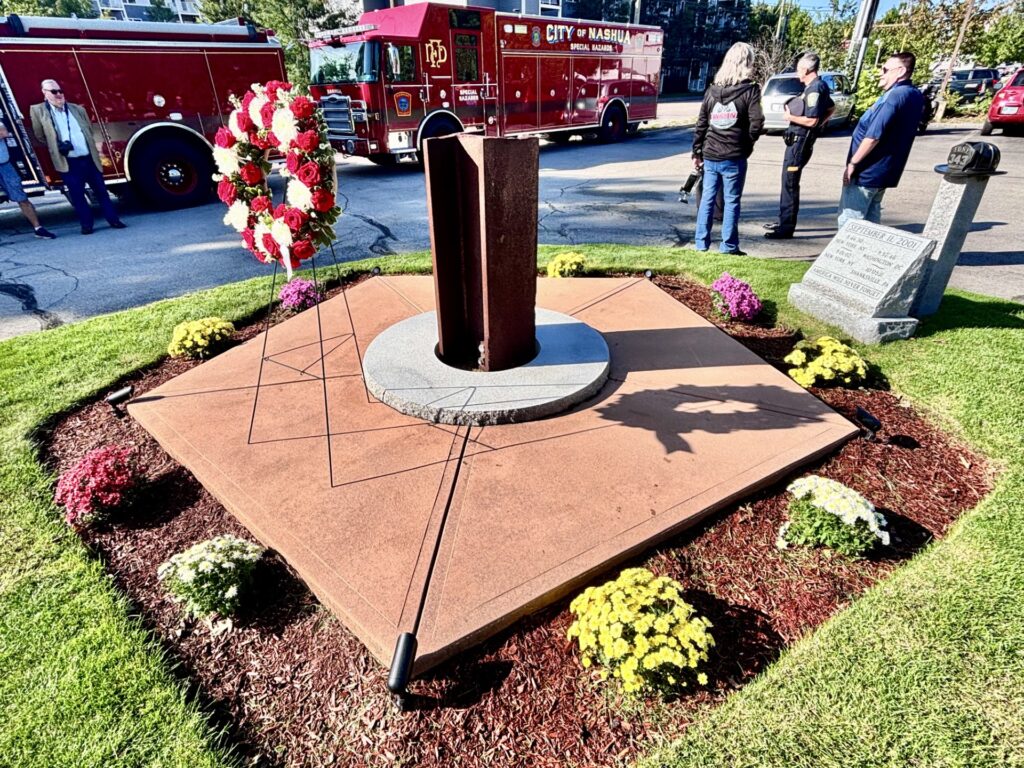
The Sept. 11 Memorial in front of the East Hollis Street Fire Station features a 640-pound piece of steel from the World Trade Center. Cabinet photo by CHRISTOPHER ROBERSON
Perhaps the most telling are the countless radio transmissions and interviews that have been released over the years.
Despite a torrential rainstorm the night before, Sept. 11 started out as a beautiful late summer day.
Flight 11 had taken off from Logan International Airport at 7:59 a.m. bound for Los Angeles. From his office on Northeastern Boulevard in Nashua, air traffic controller Peter Zalewski instructed the crew to turn 20 degrees right at 8:13 a.m. Flight 11 responded in a routine fashion: “Twenty right, American 11.”
Sixteen seconds later, Zalewski instructed the crew to climb to 35,000 feet — however, this time there was no response. He tried for 10 minutes to contact the aircraft on both its normal and emergency frequencies.
Zalewski believed Flight 11’s radio had malfunctioned and began following established procedures for a NORDO aircraft.
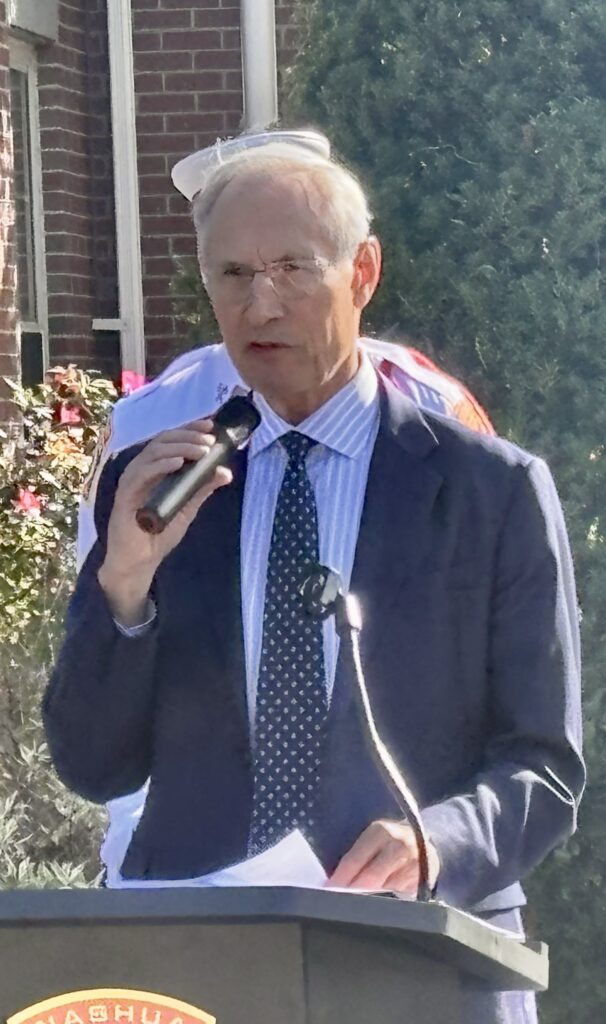
Mayor James Donchess delivers his remarks during this year's Sept. 11 Remembrance Ceremony at the East Hollis Street Fire Station. Cabinet photo by CHRISTOPHER ROBERSON
At 8:21 a.m., lead hijacker Mohammed Atta turned off the plane’s transponder, which caused its callsign and altitude to vanish. At that point, Zalewski became the first person to realize that something was seriously wrong.
Three minutes later, Zalewski heard a transmission from Atta that was intended for the 82 passengers and crew: “We have some planes. Just stay quiet and you’ll be okay. We are returning to the airport.”
At 8:46 a.m., Flight 11, traveling at 466 miles per hour, slammed into floors 93 through 99 of the North Tower.
Less than a minute later, Engine 10 firefighters gave the first real indication as to the gravity of the situation: “Send every available ambulance, everything you’ve got, to the World Trade Center now.”
Firefighter Joseph Casaliggi of Engine 7 recalled watching office workers jump from the upper floors and slam into the pavement at 150 mph.
“I just remember looking up and thinking, ‘how bad is it up there that the better option is to jump?'” he said.
There was no training for something of this magnitude, there was no plan.
At 9:45 a.m., Ben Sliney, national operations manager for the Federal Aviation Administration, ordered the unprecedented closure of all American airspace. It was also his first day on the job.
Battalion 7 Chief Orio Palmer responded to the South Tower, which was hit at 9:03 a.m. by United Airlines Flight 175. He singlehandedly repaired an elevator and made it to the 41st floor with Fire Marshal Ronald Bucca. From there, Palmer and Bucca, both seasoned marathon runners, reached the impact zone on the 78th floor.
Palmer reported his assessment at 9:52 a.m. At the time, the fires still seemed manageable.
“Battalion 7 — Ladder 15, we’ve got two isolated pockets of fire,” he said. “We should be able to knock it down with two lines.”
What Palmer and Bucca did not know was that the fires were being fed by thousands of gallons of jet fuel which was steadily melting the building’s support columns. Seven minutes later, the exterior columns on the 80th floor gave way. Palmer and Bucca were killed in the collapse.
CNN reporter Aaron Brown was a mile-and-a-half away, reporting from the roof of the network’s New York Bureau, when the South Tower collapsed.
“There has just been a huge explosion,” he said. “We can see billowing smoke rising and I’ll tell you that I can’t see that second tower.”
Capt. Jay Jonas of Ladder 6 remembered the horror that he and his men faced as they approached the burning towers.
“We turned the corner onto Canal Street and what you saw — was a nightmare,” he said.
Jonas and his men were on the 27th floor of the North Tower when the South Tower fell at 9:59 a.m.
Now in a race against time, Jonas ordered his men out of the building. At the 20th floor, they found Josephine Harris, a secretary with the Port Authority of New York and New Jersey, who had already descended 53 flights.
Suffering from an old injury, Harris struggled to make it down the stairs even with the firefighters’ assistance.
Harris and the men of Ladder 6 were in Stairwell B on the fourth floor when the North Tower came down at 10:28 a.m. Unlike the South Tower, the exterior columns of the North Tower fell outward creating a protective cocoon at the bottom of the building. By the time the collapse reached the fourth floor, the kinetic energy had diminished to the point where it was survivable. Harris, Jonas and his firefighters were among the 14 individuals who ultimately walked out.
From the 2,977 people who were killed that day, 2,753 of them died at the World Trade Center. Cantor Fitzgerald, which occupied floors 101 through 105 of the North Tower, lost 658 employees — the most of any organization in either tower. The New York City Fire Department lost 343 of its members including Father Mychal Judge and Chief of Department Peter Ganci, making 9/11 the deadliest day in the department’s history. The attacks also took the lives of 23 New York City Police officers and 37 Port Authority police officers.
Even in the face of so much death, there were still many heroes.
Port Authority construction manager Frank De Martini and his colleague, former Navy SEAL Pablo Ortiz, left their offices on the 88th floor of the North Tower and saved 77 lives before they were killed when the tower collapsed.
Also in the North Tower, Harry Ramos, a head trader at the May Davis Group, started down 87 flights when he encountered Victor Wald, a stockbroker for Avalon Partners, who had made his way from the 84th floor to the 59th floor before collapsing. Until that time, Ramos and Wald had never met; however, Ramos refused to leave Wald behind. The two men made it to the 36th floor and were killed when the tower came down. Ramos was the only May Davis employee who died that day.
In the South Tower, Brian Clark, an executive vice president at Euro Brokers, was evacuating from the 84th floor. When he reached the 81st floor, Clark heard muffled cries for help. Stanley Praimnath, an assistant vice president at Fuji Bank, was trapped in his office. He survived the initial impact as Flight 175 struck the building at an angle, sparing his office from the inferno. Clark found Praimnath at the bottom of a sheet of drywall. He coaxed Praimnath up the wall, grabbed his hand and pulled him out of the office. Clark and Praimnath also did not know each other prior to 9/11. They made it out of the tower four minutes before it collapsed.
- Merrimack resident Kenneth Reilly spoke about how he was supposed to be on American Airlines Flight 11 during this year’s Sept. 11 Remembrance Ceremony at American Legion Post 98 in Merrimack. Cabinet photo by CHRISTOPHER ROBERSON
- John Elias, commander of American Legion Post 98, delivers his remarks during this year’s Sept. 11 Remembrance Ceremony at American Legion Post 98 in Merrimack. Cabinet photo by CHRISTOPHER ROBERSON
- Merrimack Fire Chief Joseph Guarnera delivers his remarks during this year’s Sept. 11 Remembrance Ceremony at American Legion Post 98 in Merrimack. Cabinet photo by CHRISTOPHER ROBERSON
- The Sept. 11 Memorial in front of the East Hollis Street Fire Station features a 640-pound piece of steel from the World Trade Center. Cabinet photo by CHRISTOPHER ROBERSON
- Mayor James Donchess delivers his remarks during this year’s Sept. 11 Remembrance Ceremony at the East Hollis Street Fire Station. Cabinet photo by CHRISTOPHER ROBERSON
Cabinet News
Student ID cards not valid for voting

Tang Williams not backing down, continues to attack Goodlander
Milford man pleads guilty to killing father
Warmington fighting to stay in governor’s race
Goodlander and Tang Williams share views on range of topics