Loon Cam streaming live from Lakes Region
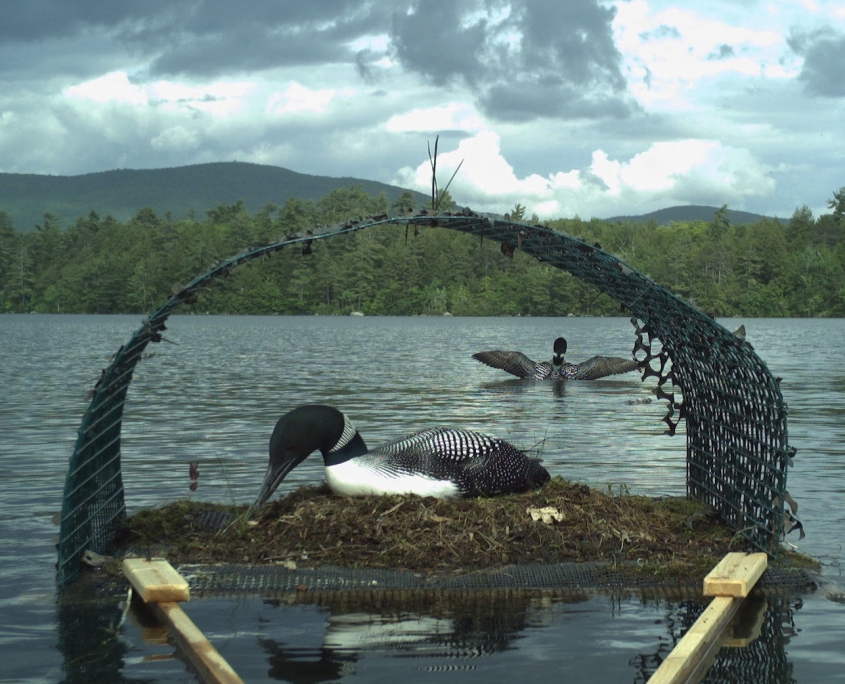
A pair of loons on Squam Lake using a nest raft installed by the Loon Preservation Committee. Since 2014, the LPC has set up more than 80 nest rafts in the Lakes Region. Courtesy photo/Loon Preservation Committee
MOULTONBOROUGH — A pair of loons in the state’s Lakes Region recently laid their eggs live on camera.
Operated by the Loon Preservation Committee, the Live Loon Cam is streaming on YouTube and can be accessed at loon.org/looncam. The eggs were laid between May 22-25 and hatching is expected between June 18-20.
Since 2014, the LPC has set up more than 80 nest rafts on Lake Waukewan, Lake Kanasatka, Winona Lake, Wakondah Pond, Lake Winnipesaukee and Squam Lake.
In addition to watching the loons, viewers also have the option to participate in an online chat to have their questions about loons answered by other viewers and LPC biologists. The chat allows viewers to share events that happen on camera, connect and socialize over their love for loons.
Loons build their nests on the ground, usually along the shoreline of islands, in marshy areas or along the mainland shoreline of protected coves. Because they have adapted for life in the water, loons cannot walk on land. Therefore, they build their nests at the water’s edge making them vulnerable to boat wakes and human disturbance.
“Because they cannot walk well on land, loons are vulnerable when they are nesting,” said LPC Director Harry Vogel. “If they sense a threat, such as a closely approaching boat, they will flatten themselves low over their nests, with their heads angled toward the water, to try to hide. If the threat persists in the area, they will flush from their nests.”
If adult loons are flushed from the nest, their eggs may be exposed to predators or temperature changes that can threaten the lives of the unborn chicks.
If a loon nest is found, it should be given plenty of space, at least 150 feet, and more if the loon shows signs of distress, such as lowering its head over the nest. Boaters are also urged to follow the no wake laws to avoid swamping loon nests.
The LPC monitors the birds throughout the state as part of its mission to restore and maintain a healthy loon population, to monitor the health and productivity of loon populations as sentinels of environmental quality and to promote a greater understanding of loons and the natural world.
Cabinet News
Find Your Farm Wellness

Local students named National Merit Scholarship semifinalists

Thank You Project hosts 11th annual Water Walk

Nashua and Merrimack recognize 25th anniversary of 9/11

Six Bedford businesses named Best Companies to Work For