Pass Along Project donors thanked for helping foster children
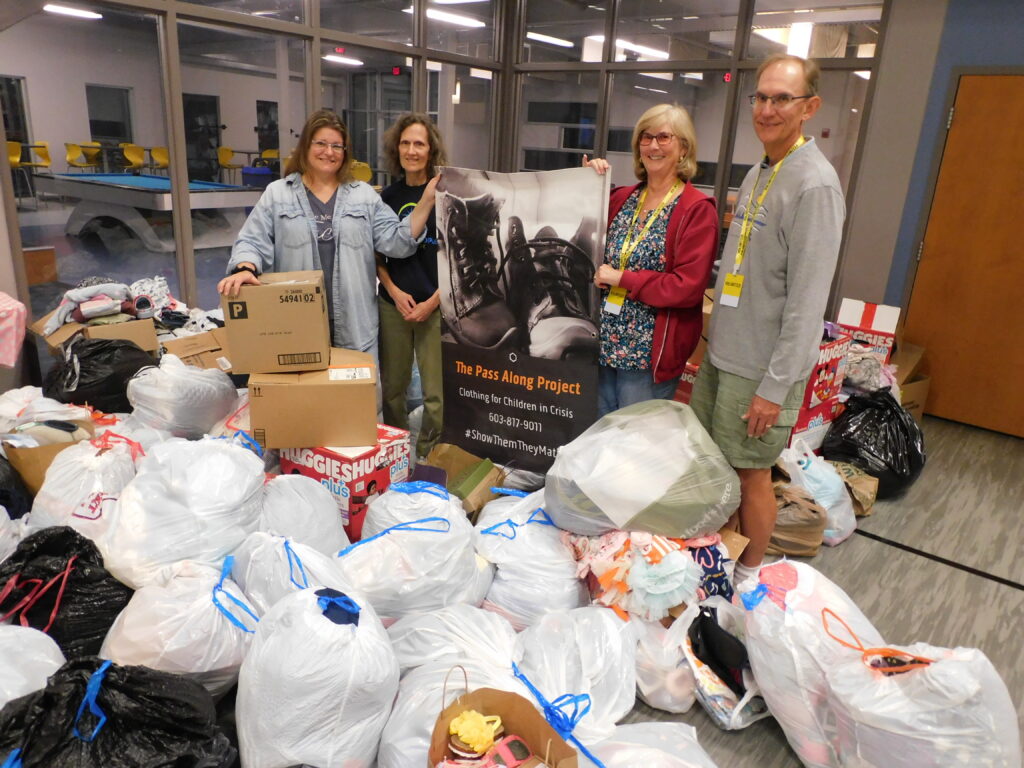
The Pass Along Project's recent roundup of donations at Manchester Community College is well appreciated at a clothing sorting and boxing event by these facilitators, from left, Lynette Kaichen, founder and director of The Pass Along Project, Aileen Clay, Manchester Community College director of student life, Sheri Simpson and Bob Siegwarth, volunteers from Allenstown. Photo by LORETTA JACKSON
A child entering foster care may have little notice that life is about to change. Often, the child arrives at a new foster or kinship home with little more than the clothing they are wearing.
Within hours, The Pass Along Project can provide something simple but meaningful: a complete wardrobe in the child’s size, thoughtfully prepared with clothing, pajamas, new underwear and socks, shoes and seasonal necessities.
The colorful bounty originates with The Pass Along Project, a New Hampshire nonprofit founded by longtime foster parent Lynette Kaichen. A dedicated network of volunteers and donors is appreciated.
The organization provides complete clothing bundles to children entering foster care and other crisis situations involving clothing scarcity.
“For us, this has always been about more than clothing,” said Kaichen. “When children are going through an enormous transition, having clothing that fits them, that was chosen and prepared especially for them, is one small way we can provide comfort, dignity and a sense that someone cares.”
The organization was launched in 2018 after Kaichen and her husband experienced firsthand how quickly a foster placement can happen. As new foster parents, they learned that two young boys would be arriving at their home within the hour — and that they would be arriving without the clothing and everyday necessities children need.
That experience exposed a challenge encountered by many foster and kinship families. A family may be prepared to open its home to a child, but there is no way to keep a wardrobe on hand for every possible age, size and season.
Kaichen began The Pass Along Project with a simple idea: prepare complete wardrobes in advance so that when a child needs clothing, the right size can be ready to go.
Today, donated new and gently used clothing is carefully sorted by volunteers and used to create complete clothing bundles in sizes ranging from Preemie through Adult 5XL.
Each bundle is designed to give a child a full starter wardrobe, typically including seven to 10 outfits, along with pajamas, new underwear and socks, shoes and seasonal essentials such as sweatshirts, coats and boots.
The clothing is packed and ready before the child ever needs it, allowing The Pass Along Project to respond quickly when a request comes in.
Kaichen said that the items going into each clothing bundle matters just as much as how quickly it can be delivered.
Volunteers sort through donations carefully, selecting apparel that is current, age-appropriate and something they believe a child would be happy to wear.
A toddler might receive a shirt covered in fairies. Another child might discover a favorite superhero. A teenager might find a sweatshirt or pair of sneakers that feels like something they would have chosen for themselves.
Those details are intentional.
Children entering foster care have already experienced significant uncertainty and change. The goal of The Pass Along Project is to make sure clothing is one thing they don’t have to worry about — and that what they receive feels like a wardrobe prepared for them, rather than simply a collection of donated items.
That mission received an enormous boost Oct. 2-3, when Manchester Community College became the site of The Pass Along Project’s Fall 2026 Clothing Drive and Sorting Event.
The community arrived with hundreds of bags filled with brand-new and gently used clothing and footwear in sizes and seasons spanning infancy through adulthood. Dozens of volunteers then went to work sorting the donations by gender and size so they can ultimately become complete wardrobes for children who need them.
Tables and boxes filled with clothing stretched along the sorting area as volunteers worked their way through the mountain of donations — children’s sizes, teen sizes and adult sizes alike.
Adult clothing is particularly important to the organization, as children often begin wearing adult sizes as early as age 12.
For Kaichen, the sheer volume of clothing represented far more than a successful donation drive.
“Every bag that came through those doors represents clothing that can now go to a child who needs it,” Kaichen said.
“When you look around and see hundreds of bags of clothing and dozens of people giving their time to sort it, you’re seeing an entire community step up for children they may never meet. That’s what made this weekend so incredible,” she added.
The work continues long after the sorting event ends. Volunteers will use the organized inventory to assemble complete clothing bundles, ready to be provided when a child enters foster care or another crisis situation and needs clothing quickly.
What began with one foster family’s experience has grown into a statewide effort, one powered by people willing to donate clothing, give their time and help make a difficult transition a little easier for a child.
And sometimes, that comfort begins with something as ordinary — and as important — as opening a bag and finding clothes that fit.
More information about The Pass Along Project, including ways to donate or volunteer, is available at www.thepassalongproject.com.
Cabinet News
As election looms, Sununu cites how he is different than Trump

Nashua Chamber to host candidate conversations
Record turnout of 130 entries at Amherst Lions Club Car and Truck Show

Nashua Rotary Club to host candidate discussions

Former Granite State residents charged with theft, money laundering